- Foley, Alabama
- admiraldibeler@gmail.com

Work safely in hazardous environments — with the certification to prove it. Admiral D Consultants’ HAZWOPER 24 Hour Training program provides limited site workers in the petrochemical and construction industries with the comprehensive knowledge, skills, and OSHA-recognized certification required to operate safely at hazardous waste sites and in environments involving hazardous substance exposure.
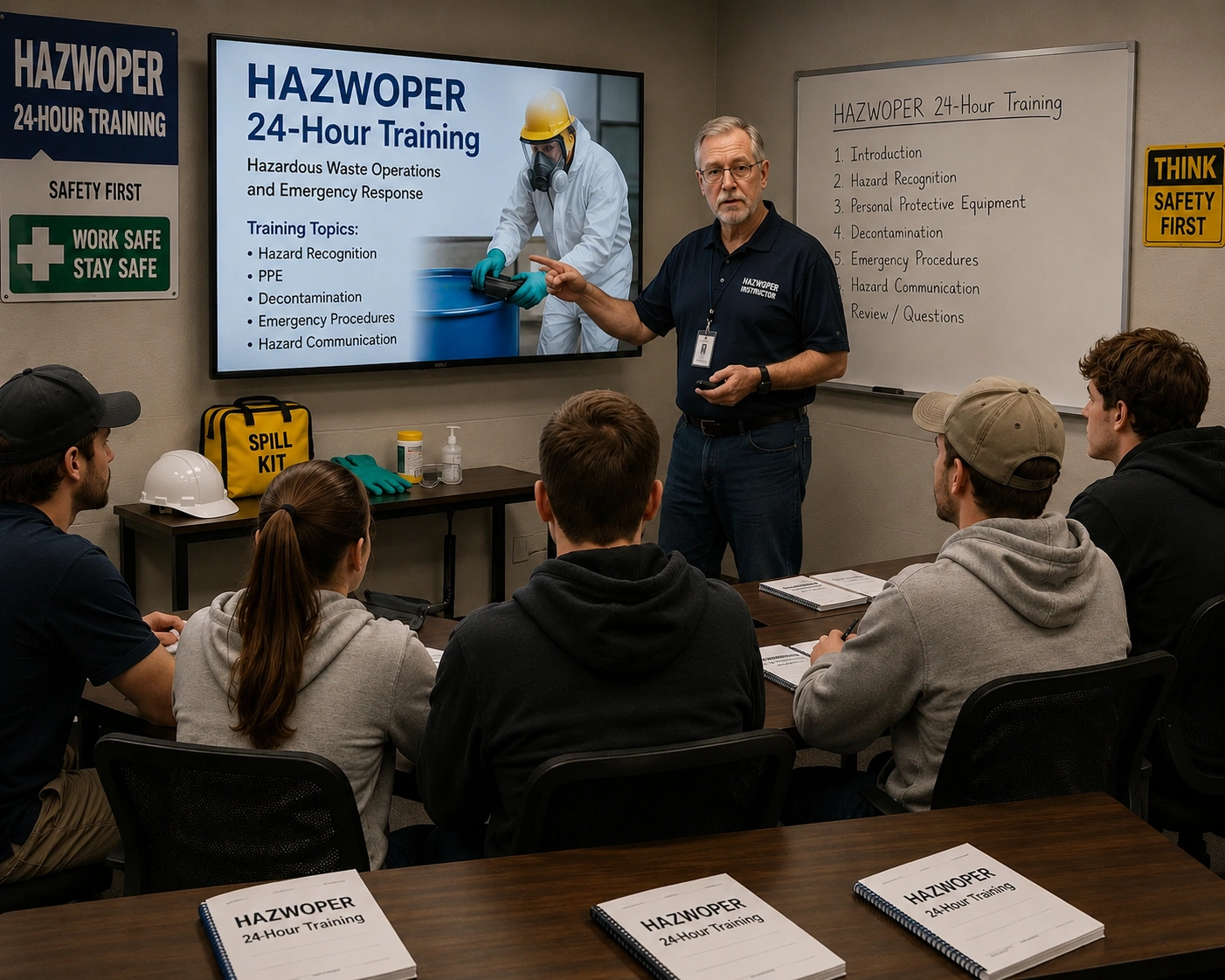
HAZWOPER stands for Hazardous Waste Operations and Emergency Response. Under OSHA standard 29 CFR 1910.120, workers who have limited exposure to hazardous waste sites — classified as “limited site workers” — are required to complete a minimum of 24 hours of initial HAZWOPER training before working in those environments.
The HAZWOPER 24 Hour Training course is designed specifically for this category of worker. It provides a thorough grounding in hazardous waste site operations, chemical hazard recognition, personal protective equipment, emergency response procedures, and the regulatory framework that governs safe work in these environments.
Upon successful completion, participants receive their HAZWOPER 24 Hour certification — a credential that authorizes them to work as limited site workers at hazardous waste operations covered under the OSHA HAZWOPER standard. Certified workers are also required to complete the HAZWOPER 8 Hour Annual Refresher each year to maintain their certification.
At Admiral D Consultants, our HAZWOPER 24 Hour course is delivered by instructors with real-world experience in hazardous work environments across both the petrochemical and construction industries. Our training is practical, rigorous, and designed to genuinely prepare workers for the conditions they will encounter on the job.

The HAZWOPER 24 Hour Training is designed for workers who have limited and controlled access to hazardous waste sites or environments involving hazardous substance exposure. This course is ideal for:
With limited access to areas involving hazardous waste, chemical spills, or contaminated materials
On job sites involving contaminated soil, hazardous building materials, or chemical exposure
Performing limited duties at hazardous waste sites or remediation projects
Who may encounter hazardous substances in the course of their regular duties
Required to hold HAZWOPER certification as a condition of site access
New workers entering HAZWOPER-covered industries
OSHA’s HAZWOPER standard defines different training requirements based on a worker’s level of site involvement. Here is a quick comparison to help you identify the right course:
| HAZWOPER 24 Hour | HAZWOPER 40 Hour | |
|---|---|---|
| Worker Type | Limited site workers | General site workers with frequent/unrestricted site access |
| Site Exposure | Limited, controlled access to hazardous areas | Regular, unrestricted access to hazardous waste sites |
| Duration | 24 Hours | 40 Hours |
| Annual Refresher Required | Yes — 8 Hours per year | Yes — 8 Hours per year |
| OSHA Standard | 29 CFR 1910.120 | 29 CFR 1910.120 |
| Detail | Information |
|---|---|
| Course Duration | 24 Hours |
| Training Type | Initial HAZWOPER Certification — Limited Site Worker |
| OSHA Standard | 29 CFR 1910.120 |
| Format | [In-Person / Online / Both — update as applicable] |
| Certification Awarded | HAZWOPER 24 Hour Completion Certificate |
| Annual Refresher Required | Yes — HAZWOPER 8 Hour Refresher each year |
| Availability | Nationwide |
| Scheduling | Flexible — contact us to arrange |
A: A limited site worker, as defined under OSHA’s HAZWOPER standard (29 CFR 1910.120), is a worker who visits a hazardous waste site but whose activities are limited in scope and exposure. Limited site workers do not perform cleanup or remediation tasks directly — they may include certain contractors, inspection personnel, or support workers who enter hazardous areas on a controlled and infrequent basis. These workers are required to complete a minimum of 24 hours of HAZWOPER training.
A: No. The HAZWOPER 24 Hour course is specifically designed for limited site workers, while the 40 Hour course is intended for workers with regular, unrestricted access to hazardous waste sites. Both courses cover similar foundational topics, but the 40 Hour program goes into greater depth and is required for workers with more extensive site involvement. Contact Admiral D Consultants if you are unsure which course applies to your situation.
A: Yes. All HAZWOPER-certified workers — regardless of whether they completed the 24 Hour or 40 Hour initial training — are required by OSHA to complete an 8-hour annual refresher course each year to maintain their certification. Admiral D Consultants offers the HAZWOPER 8 Hour Annual Refresher course to keep your certification current.
A: The course requires 24 instructional hours, which is typically delivered over three days. Admiral D Consultants offers flexible scheduling to accommodate individuals and corporate teams. Contact us to discuss scheduling options that work for you.
A: Yes. We offer custom on-site corporate training solutions for organizations looking to certify multiple workers at their facility or job site. Our instructors travel nationwide to deliver training directly at your location, minimizing downtime and operational disruption. Contact us to request a corporate training quote.
The OSHA 24-Hour HAZWOPER (Hazardous Waste Operations and Emergency Response) course is designed for workers who are on-site occasionally for specific limited tasks and are unlikely to be exposed over permissible exposure limits (PELs). It is also the standard entry-level training for Emergency Responders at the First Responder Offensive Level (Technician Level) under 29 CFR 1910.120(q).
To satisfy OSHA standards 29 CFR 1910.120 (General Industry) and 29 CFR 1926.65 (Construction), the course must cover a specific layout of core safety, regulatory, and technical competencies.
Scope of HAZWOPER: Understanding the three pillars of the standard (Uncontrolled hazardous waste sites, TSD facilities, and emergency response operations).
Key Agencies: The roles of OSHA, the EPA, the DOT, and NIOSH in hazardous material regulation.
Chemical, Physical, and Biological Hazards: Identifying safety and health hazards on a site (e.g., fire, explosion, toxicity, ionizing radiation).
Chemical Properties: Understanding material behaviors, including vapor pressure, flash points, pH, lower/upper explosive limits (LEL/UEL), and compatibility.
Recognition Systems: Utilizing the Department of Transportation (DOT) Plackarding system, NFPA 704 diamond, and Global Harmonized System (GHS) labeling.
Routes of Entry: How chemicals enter the body (inhalation, ingestion, skin absorption, injection).
Acute vs. Chronic Health Effects: Recognizing immediate symptoms versus long-term illnesses.
Navigating Exposure Limits: Interpreting OSHA Permissible Exposure Limits (PELs), ACGIH Threshold Limit Values (TLVs), and IDLH (Immediately Dangerous to Life or Health) designations.
Levels of Protection: Comprehensive training on the selection, capabilities, and limitations of Levels A, B, C, and D protective ensembles.
Respiratory Protection: Inspection, fit-testing concepts, and differences between Air-Purifying Respirators (APR) and Atmosphere-Supplying Respirators (SCBA and Supplied-Air Systems).
Chemical Protective Clothing (CPC): Understanding breakthrough times, permeation rates, and degradation.
Work Zones: Establishing the boundaries for the Hot Zone (Exclusion), Warm Zone (Contamination Reduction), and Cold Zone (Support).
The Site Safety and Health Plan (HASP): Navigating and understanding the elements required in a site-specific safety plan.
Medical Surveillance: Identifying when workers must be enrolled in medical monitoring programs.
Decon Line Setup: Designing and operating physical decontamination stations for personnel and equipment.
Preventing Cross-Contamination: Proper methods for the safe doffing (removal) of contaminated PPE without exposing the worker or clean environments.
Incident Command System (ICS): Introduction to standard organizational structures used to manage emergency response operations.
Spill Containment: Basic offensive and defensive tactics for controlling a release (e.g., diking, damming, absorbing, and patching/plugging containers).
Drum & Container Handling: Safe procedures for inspecting, opening, and sampling uncharacterized storage drums.
Target Audience: Typically required for Occasional Site Workers (who do not face exposures above PELs and do not wear respirators regularly) or initial emergency response team members.
Field Experience Component: Unlike the 10-hour or 30-hour Outreach courses, OSHA HAZWOPER standards explicitly state that classroom or online training must be supplemented by at least 1 day (8 hours) of actual field experience under the direct supervision of a trained, experienced supervisor.
Upgrade to 40-Hour: If an occasional worker’s duties change, requiring regular respirator use or exposing them to hazards above PELs, they must complete the remaining 16 hours of training to upgrade to the full 40-Hour certification.
Maintenance: To keep this certification active, the worker must complete an 8-Hour HAZWOPER Refresher annually.